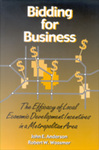
[cover]

Bidding for Business

The Efficacy of Local Economic Development
Incentives in a Metropolitan Area

John E. Anderson, University of Nebraska
Robert W. Wassmer, California State University-Sacramento

Introductory chapter | Table of Contents

As communities go toe-to-toe in battles to attract capital and jobs to their depressed areas, local policy makers are left to ponder the success of these costly efforts. Are the litany of economic incentives provided by cities to firms for relocation or expansion worth the cost? Do local economic incentives bring jobs to areas with high levels of unemployment? Or are economic incentives little more than corporate welfare?

Anderson and Wassmer examine the use and effectiveness of local economic development incentives within a specific region, the Detroit metropolitan area. The Detroit area serves as a good example, they say, because of the area's 20-plus year track record of its communities offering the gamut of economic incentives aimed at redirecting economic activity and jobs. The evidence they uncover reveals factors that drive cities not just in this Southeast Michigan area, but nationwide to offer particular types of incentives that are more or less generous than those offered by their neighbors.

Their work also shows how the redistribution of economic activity within most metropolitan areas has created a spatial mismatch between low-skilled employees living in central cities and inner suburbs and potential employers located increasingly farther out in suburbia.

Anderson and Wassmer begin by presenting an overview of the types of local economic incentives offered in the U.S. and their use within regions. They also offer an interesting discussion of why an offer/counteroffer situation is more likely to occur between two competing cities within a metropolitan region than it is among two states or two regions, and a statistical framework for examining the effectiveness of local incentives.

This statistical analysis includes simulations of what would happen if the typical community in the Detroit area increased its offering of manufacturing abatements, commercial abatements, or industrial development bonds (IDBs) by $10 million, or if it went from not offering a tax increment financing authority (TIFA) or downtown development authority (DDA), to offering one or the other.

The authors are also able to show that core cities exhibited a greater propensity to offer incentives than did periphery cities, which is not surprising. But they also produce evidence showing that, over time, periphery cities offered more incentives merely because neighboring cities were offering them. Also, periphery cities, with the exception of industrial development bonds, are more likely to offer local incentives (relative to a core community) the longer that the incentive program is in existence.

"Since we know that the fiscal blight experienced in core cities relative to periphery cities got no better over this period (a case could be made for it getting worse)," they say, "bidding for business was the likely reason that periphery cities used a greater number of incentives over time."

Related titles
  • Reining in the Competition for Capital, Ann Markusen, Editor
  • Does "Trickle Down" Work?, Joseph Persky, Daniel Felsenstein, and Virginia Carlson
  • State Enterprise Zone Programs: Have They Worked?, Alan H. Peters and Peter Fisher
  • Changes in Income Inequality within U.S. Metropolitan Areas, Janice F. Madden
  • Industrial Incentives: Competition Among American States and Cities, Peter S. Fisher and Alan H. Peters
  • Plant Closings and Worker Displacement: The Regional Issues, Marie Howland
  • Who Benefits from State and Local Economic Development Policies?, Timothy J. Bartik
    Also visit our Economic Development and Local Labor Markets Research Hub.
  • Anderson and Wassmer use this finding and the results of their simulations to evaluate the three policy choices for the future of local incentive activity in a region. "Among the three policy options, the outright ban on all local economic development incentives in a metropolitan area is not our preferred policy choice," say the authors. "We agree with a prohibition of local incentive offers if the only other policy option is continued free rein. The targeted use of local incentives by communities that are fiscally blighted, and that would enjoy large social benefits when a firm resides with their boundary, is our preferred policy option."

    "Communities and policymakers should find the conclusions intriguing...[those conclusions] challenge communities to rethink how it is they can best promote their own economic development." APA Journal

    "I recommend [this] book for researchers and economic development practitioners who wish to achieve a more thorough understanding of the use of tax incentives in a metropolitan setting." Ernest Gross, Urban Studies

    220 pp. 2000
    $40 cloth ISBN 0-88099-202-6 / ISBN-13 978-0-88099-202-2
    $17 paper ISBN 0-88099-201-8 / ISBN-13 978-0-88099-201-5


    Shopping Cart Operations

    For MasterCard/Visa holders, accumulate titles in the Shopping Cart and submit your order electronically.

    Shopping Cart Operations


    Customer Service - for phone, fax or mail orders, if you have any questions, or if you'd like to download our order form.
    Alphabetical List of Books   |   Publications   |   Home Page